















Ireland's Updated E-Scooter, E-Bike and Scrambler Laws: What You Need to Know in 2026
Things have been moving fast on the legislative front here in Ireland. If you own or are thinking about buying an electric scooter, e-bike, or off-road scrambler, there are some important legal changes you need to be aware of — particularly a new statutory instrument that came into force on 3 April 2026.
At Inner City Scooters, we believe that the best way to enjoy your ride is to do it safely, legally, and with confidence. That is why we have pulled together this guide to help you understand exactly where things stand, what the rules mean for your vehicle, and how we approach responsible e-mobility at ICS.
Important notice: This page provides general guidance only. It does not constitute legal advice. For confirmation of your specific vehicle’s legal status, always check with the RSA or a qualified legal professional.
What changed in April 2026?
On 3 April 2026, S.I. No. 123 of 2026 — the Road Traffic (Control of Certain Vehicles) Regulations 2026 came into operation. Signed by Minister for Transport Darragh O’Brien, this new regulation introduced clear, enforceable restrictions on the use of off-road motorcycles in Ireland.
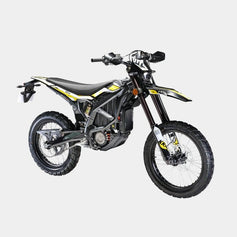
This is a significant development. For the first time, there is a specific statutory instrument that explicitly names and restricts the use of vehicles like scramblers, dirt bikes, pit bikes, trail bikes, quad bikes, motorised trikes, go-carts, and off-road buggies — and gives An Garda Síochána direct powers to request proof of lawful use on the spot.
Here is a plain-English summary of what the new regulation says:
- The use of an off-road motorcycle in any place is prohibited, unless an exemption applies.
- The exemptions are narrow: use is only lawful on land by the owner or occupier of that land, or by someone with the written consent of the landowner.
- A Garda may stop a rider and ask them to identify the owner of the land, produce written consent, or demonstrate that they are the owner or occupier.
- Vehicles that already carry an identification mark under section 131 of the Finance Act 1992 (i.e., are properly registered) are exempt from this restriction.
In short: if you ride a scrambler, dirt bike, or pit bike in a public place, a car park, a park, a road, or on any land without proper written permission — you are now in breach of this regulation.
E-scooter rules in Ireland: a quick recap
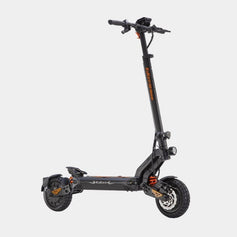
According to RSA guidance, a legally compliant e-scooter for use in public places in Ireland must meet all of the following criteria:
- Minimum rider age: 16 years
- Maximum continuous rated output: 400W
- Maximum design speed: 20 km/h
- Maximum weight including battery: 25 kg
- Minimum wheel diameter: 200 mm
- No seat is permitted
- Required equipment: lights, reflectors, brakes, and a bell or audible warning device
E-scooter riders must follow the rules of the road in a similar way to cyclists. They may use public roads, cycle lanes, and bus lanes where permitted. They may not use footpaths, pedestrianised areas, or motorways, and they must not carry passengers or use a mobile phone while riding.
If your scooter exceeds any of these limits, it is generally not legal for public-road use under the standard e-scooter rules and may fall into a different vehicle class. For full details, visit the RSA’s e-scooter guidance page.
E-bike rules in Ireland: what you need to know
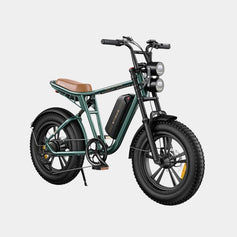
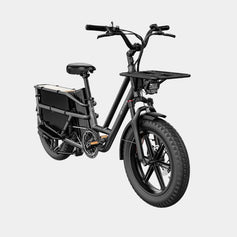
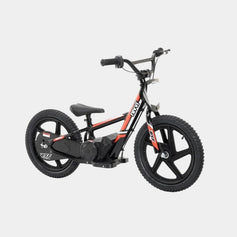
Standard low-powered e-bikes continue to be treated similarly to bicycles under Irish law, provided they meet the accepted limits. In general terms, a compliant e-bike must be a pedal-assist bicycle with a motor output of up to 250W, where the motor assistance cuts off automatically at 25 km/h.
Compliant e-bikes may use cycle lanes and bus lanes in the same way as bicycles. They must not be used on footpaths, and riders must follow the rules of the road.
It is important to understand that not all electric bikes sold on the market fall within these limits. If a bike includes a throttle-only mode, has power or speed capabilities above the standard threshold, or is more accurately described as an e-moped, it may require registration, tax, insurance, and a driving licence. Vehicle classification matters — and the buyer is responsible for understanding what class their vehicle falls into.
For more information, see the RSA’s guidance on powered personal transportation and e-bikes.
Scramblers and off-road vehicles: the new crackdown
This is where the biggest change in 2026 lies. S.I. No. 123 of 2026 targets scramblers, dirt bikes, pit bikes, trail bikes, quad bikes, motorised trikes, go-carts, and off-road buggies — all vehicles that have been causing problems on roads, parks, and housing estates across Ireland.
Under the new regulation, use of these vehicles in any place is prohibited unless you are the owner or occupier of the land, or you have the written permission of the landowner. Garda can stop you and ask for proof. This is not a grey area.
Using these vehicles on public roads, paths, parks, housing estates, or any land without written permission is now explicitly unlawful. Consequences include the risk of prosecution, seizure of the vehicle, and other legal penalties.
Inner City Scooters’ guidelines for all riders
At ICS, we take our responsibilities as a retailer seriously. Here is what we recommend for every rider:
- Know your vehicle category. Understand whether your vehicle is a compliant e-scooter, a compliant e-bike, a higher-powered vehicle requiring registration, or an off-road-only model. When in doubt, ask us before you buy.
- Always wear protective equipment. At minimum, a properly fitted helmet. For higher-powered vehicles, consider full protective gear including gloves, knee pads, and appropriate footwear.
- Ride sober and alert. Never ride under the influence of alcohol or any substance that affects your judgment.
- Do not use your phone while riding. This is illegal for e-scooter riders and dangerous for all riders.
- Respect other road users. Cycle lanes and shared paths are used by everyone — ride at appropriate speeds and give way where required.
- Keep your vehicle maintained. Check brakes, lights, tyre pressure, and battery regularly.
- Off-road vehicles go off-road only. Scramblers, dirt bikes, and similar models must be used only on private land with proper permission or at designated tracks. No exceptions.
- Do not modify your vehicle without checking its legal status first. Speed unlocking, controller changes, or throttle modifications may make a compliant vehicle non-compliant and may void your warranty.
We also strongly recommend reviewing our full E-Mobility Laws and Usage Policy for detailed guidance on every vehicle category we stock.
Our commitment at Inner City Scooters
We are proud to be one of Ireland’s leading e-mobility retailers, and we take the legal and safety side of what we do just as seriously as the products themselves. We do not simply sell vehicles and walk away. Every product on our site includes guidance on its intended use, our team is trained to advise customers honestly on vehicle classification, and we update our policies whenever the law changes.
If you are ever unsure whether a vehicle is right for your intended use, please reach out to us before you buy. You can contact us directly via innercityscooters.com/contact.
Official reference links
- Road Traffic (Control of Certain Vehicles) Regulations 2026 — S.I. No. 123 of 2026
- RSA — E-Scooter Guidance
- RSA — Powered Personal Transportation and E-Bikes
- Inner City Scooters — E-Mobility Laws and Usage Policy
Disclaimer: This blog post is provided for general information only and does not constitute legal advice. Vehicle classifications, legal requirements, and enforcement practices may change. Always verify the current legal status of your vehicle with the RSA, An Garda Síochána, or a qualified legal professional. Inner City Scooters Limited does not accept liability for any consequences arising from the use of information published on this page.